
Randolph County Court Records After Arrest
A Randolph County arrest creates a jail or arresting-agency record first. The court record is a separate file that tracks formal charges, hearings, bond orders, court dates, and case disposition. The Clerk of Superior Court page says the clerk processes and protects criminal court records and files, processes calendars, attends court proceedings, and transmits criminal records to GCIC. That makes the clerk the key local source for criminal case files after the jail booking stage.
The jail side still matters. A fresh custody question, booking charge, bond status, or hold should start with Randolph County Jail. For current custody and booking details, use Randolph County jail inmate records. For booking photos, use the Randolph County jail mugshots page. Court records after a jail arrest answer a different question: what charge was filed, what court is handling it, and what happened next.
Find Randolph County Court Records
No official Randolph County online criminal case-search portal was located on the county website during the research pass. The county Clerk of Superior Court page says the office assists agencies and the public with public search terminals. It also lists the clerk's duties for criminal files, calendars, proceedings, appeals, protective orders, and state reporting. For court records after a jail arrest, contact the clerk with the defendant name, approximate arrest date, charge, case number if known, and any court date or warrant information.
- Start with the jail if the person is still in custody and the booking is recent.
- Ask the Clerk of Superior Court for the criminal case number, filed charge, court dates, and disposition.
- Use public search terminals if the clerk directs you to an in-person record search.
- For preliminary hearings, warrants, or eligible bail, contact Magistrate Court.
- For statewide criminal-history reports, use GBI/GCIC rather than a county case file.
Clerk of Superior Court
93 Front Street Room 118
P.O. Box 98, Cuthbert, GA 39840
229-732-2216
8 am to 5 pm, Monday through Friday.
Magistrate Court
P.O. Box 6
Cuthbert, GA 39840-0006
229-732-2218
Warrants, preliminary hearings, summons, and eligible bail.
Arrest Warrants and First Appearance
The Randolph County Magistrate Court page states that magistrate jurisdiction includes preliminary hearings, issuance of summons, arrest warrants, search warrants, and bail in cases not reserved to another court. That matters right after a jail arrest because first appearance and bond questions often pass through a judge before the formal case record is easy to track. Some serious charges may require a Superior Court judge for bond.
The sheriff's office also remains part of the warrant pathway. The county law-enforcement page says the sheriff executes arrest warrants, serves civil papers, provides court security, and operates the jail. A most-wanted page is selective and should not be treated as a full active-warrant search. If a warrant led to booking, ask whether there is any hold from another county, state agency, federal agency, or probation/parole authority.
Charges Filed After Jail Arrest
Booking charges and court charges can differ. A deputy or officer may list an arrest or booking charge at intake. The prosecutor's filing decision then controls the charge that moves through court. Randolph County research did not capture a dedicated district attorney page, so formal court-record questions should start with the Clerk of Superior Court and the court handling the case until prosecution details are verified.
| Charging Document | Who Uses It | What It Means |
|---|---|---|
| Complaint | Officer, prosecutor, or court process | Starts or supports early criminal proceedings after an arrest. |
| Accusation or Information | Prosecutor | Formal prosecutor-filed charge in many Georgia criminal cases. |
| Indictment | Grand jury | Grand-jury charging document, common for serious felony matters. |
Randolph County Charge Status
Court records after a jail arrest should be read by charge status, not just by the first booking label. A charge may be pending, amended, reduced, dismissed, or resolved by plea, trial, or other disposition. A court status term describes what is happening in the case. It is not the same as custody status, which tells whether the person is in jail, released on bond, transferred, or held by another agency.
| Status | What It Means |
|---|---|
| Pending | The case or charge has not reached final disposition. |
| Amended | The filed charge was changed after the original filing. |
| Reduced | The charge was lowered to a lesser offense. |
| Dismissed or nolle prosequi | The prosecution ended that charge, though other charges may remain. |
| Disposition | The final recorded outcome for the charge or case. |
| Conviction | A guilty result or adjudication. It is not the same as arrest. |
Bond Records After Arrest
Randolph County's official sheriff pages did not publish a bond-payment page or fee schedule. The Magistrate Court page is the key local source because it lists bail jurisdiction in cases not reserved to another court. To confirm bond, call Randolph County Jail at 229-732-2525 and ask whether bond has been set, which court set it, whether another hold exists, and where payment is accepted. Do not assume online payment, a payment method, or a bondsman list from unofficial sources.
| Bond or Hold Term | Plain Meaning |
|---|---|
| Cash bond | Money paid directly as security for court appearance. |
| Surety bond | A licensed bail agent posts bond under court conditions. |
| Recognizance or PR bond | Release based on promise and conditions rather than cash. |
| Property bond | Real property may secure release if allowed and approved. |
| No-bond hold | Release will not occur through posted bond until the hold is cleared or changed. |
Charges Versus Convictions
An arrest or filed charge is an accusation, not a final finding. A conviction is a court outcome after plea, trial, or other adjudication. This difference matters in Randolph County court records after arrest because a jail booking page, if one existed, would not prove a conviction. Formal disposition must be checked with the court record or a proper criminal-history source.
| Record Type | What It Shows | What It Does Not Prove |
|---|---|---|
| Arrest or booking charge | Why the person was booked into jail. | It does not prove guilt or final prosecution. |
| Filed court charge | What the prosecutor or grand jury pursued. | It may still be pending or later changed. |
| Conviction | Final guilty result or adjudication. | It does not show every arrest that did not lead to conviction. |
Sealed Expunged Confidential Records
Not every court record is open. The Randolph County clerk page notes that adoptions and juvenile records are confidential or sealed without a court order, and DD-214 military discharges are not subject to open-records inspection. Criminal records may also be restricted, sealed, or affected by Georgia record-restriction rules. Ask the clerk what is publicly inspectable and what requires a court order or different agency process.
| Term | Meaning | Where to Ask |
|---|---|---|
| Sealed | Access is limited by court order or law. | Clerk of Superior Court. |
| Expunged or restricted | Public access may be limited under state process. | Court, clerk, or GBI/GCIC guidance. |
| Confidential juvenile matter | Juvenile files are not ordinary public criminal files. | Clerk or court handling the matter. |
GBI Criminal History Records
A statewide criminal-history report is different from a Randolph County court case file. The GBI GCIC page and GCIC public portal handle Georgia criminal-history checks. GBI materials should be used when the user needs a statewide identity-based criminal-history report rather than the local court file following one jail arrest.
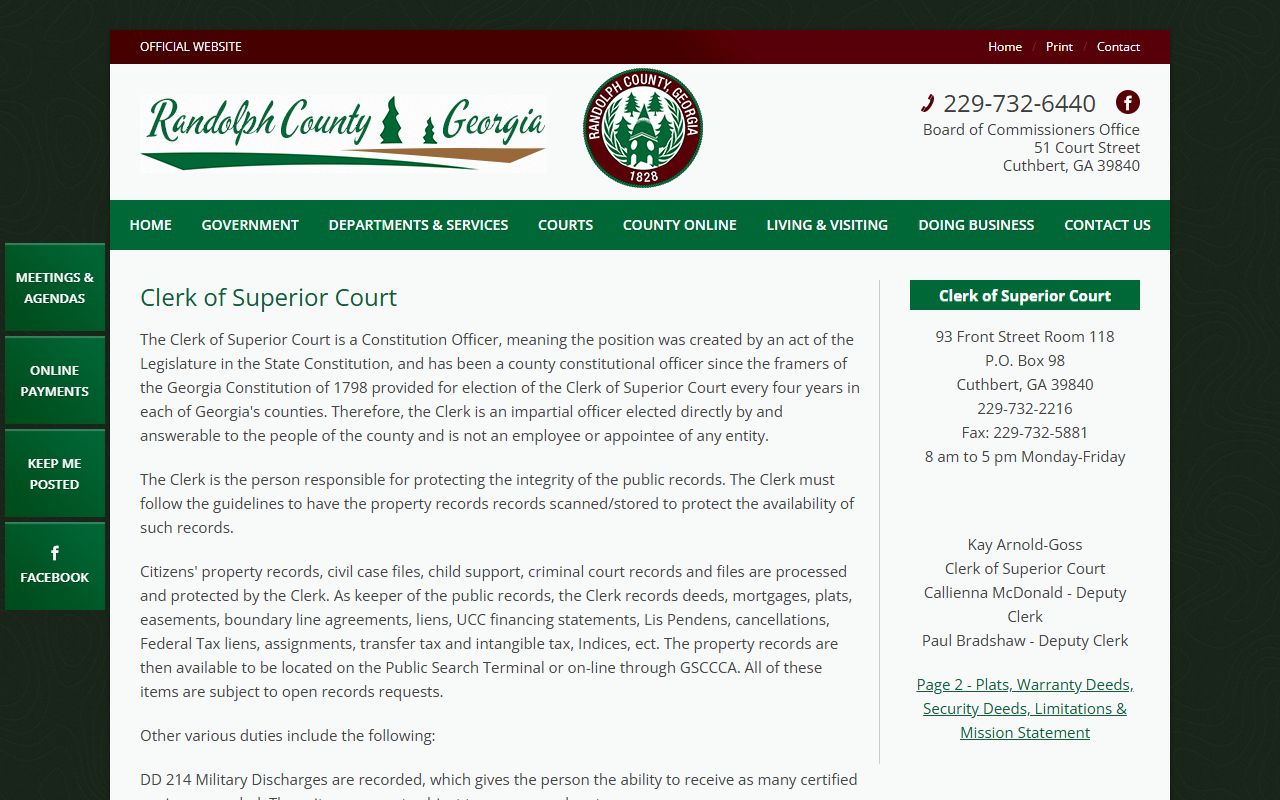
The Randolph County clerk page screenshot shows the local office that handles criminal court files and public search terminals.
Use the clerk for local court records and GCIC for statewide criminal-history checks, because the two systems answer different questions.